 |
| Haworth Parsonage, Autumn Evening |
I finished this piece, pasting the final leaf on, at about 2 o'clock this morning. Obsessive or what? Anyway, I am fairly happy with it and it captures the atmosphere I was after. Gone are the dog and the plethora of graves. It would be too easy to always plump for a strictly bleak and tragic view ... coloured by our knowledge of how their brief lives played out. It's autumnal, yes, but happy autumnal I hope. Before the advent of the grim reaper down Haworth way.
"My home is humble and unattractive to strangers, but to me it contains what I shall find nowhere else in the world - the profound, the intense affection which brothers and sisters feel for each other when their minds are cast in the same mould, their ideas from the same source - when they have clung to each other from childhood ...", said Charlotte Brontë in 1841
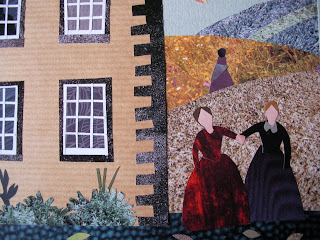 |
| Detail showing the sisters |
So there she is clinging to Anne by the side of the parsonage, Emily striding out across the moor in the background. The three large birds? The sisters' soaring imagination, with the distant Branwell perversely flying in the opposite direction, poor thing.
And there they are again, inside the plain, solid, somewhat comfortless house (their father brooked no curtains or carpets for fear of fire, apparently) looking out of the windows.
I once read a Freudian interpretation of Wuthering Heights, the author of which had counted the number of times that windows and doors featured in the work. Having lived with the facade of Haworth Parsonage for a couple of weeks I have to say that windows were an architectural feature the Brontës must have had an awful lot of trouble ignoring in their day-to-day lives.
They certainly had me cursing with the fiddly panes.
Eight years after Charlotte Brontë wrote the lines quoted above, she was to write to her friend, wryly laughing off the suggestion she take a companion (her siblings having died in the intervening years):
"... the young person whom I might request to come and bury herself in the hills of Haworth - to take a church and stony churchyard for her prospect - the dead silence of a village parsonage - in which the tick of the clock is heard all day long - and a grave, silent spinster for her companion ..."
Needless to say she didn't wish the fate on anyone.
Now that does sound a grim and tragic scenario, but even that isn't as grim and tragic as the one which would be the lot of their father who outlived them all by six years,
I feel a bleaker parsonage picture coming on ....

.jpg)


