Showing posts with label garden. Show all posts

Saturday, July 13, 2013

Jane and Cassandra relocate to the US

Sold this week, one of my most popular (card-wise) original collages:

 
Now parcelled up and ready to fly to a new home in Philadelphia.
 
But still available, of course, in giclee print form from my website:
 
and as cards and small digital prints from my online shop:

Sunday, June 23, 2013

Mrs Gaskell's earthly paradise

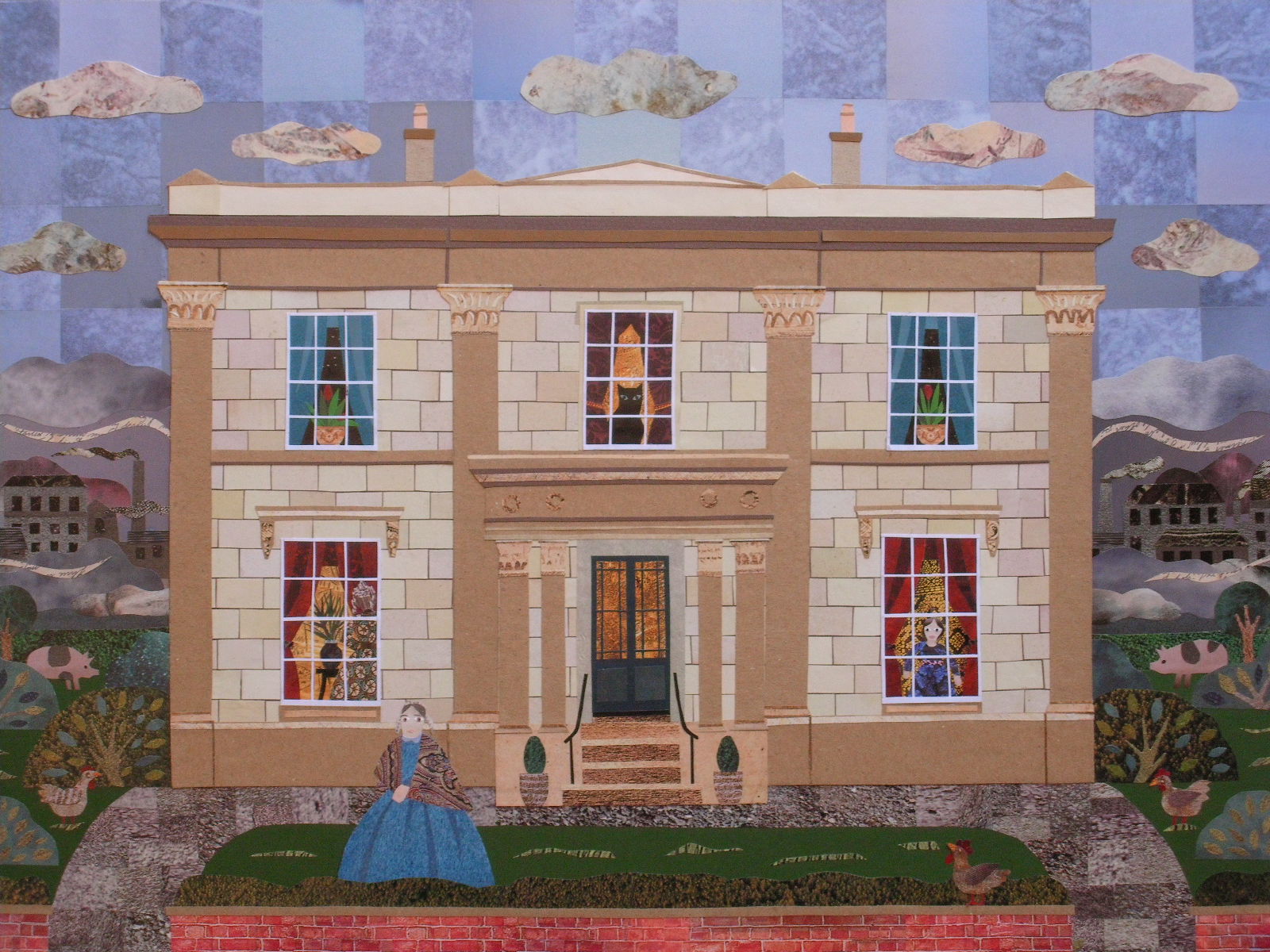
I have just put the finishing touches to my latest literary collage and here's a snap of it:

 
A bit dark, I know, but I can't get it professionally scanned for a week or two.
 
Number 42 Plymouth Grove occupied (and for all I know still does) what is commonly called a leafy suburb of Manchester, well away from the dark satanic mills of the industrial revolution. But leafy suburbs - and Italianate villas like this one - are metaphorically built upon those mills and factories and they are very much present in the writings of Mrs Gaskell. Her husband, a Unitarian minister, was involved with the manufacturing poor as well. So the mills are there, diorama-like, prominently in the background.
As is the livestock which Mr and Mrs G kept in their garden which served the double purpose of providing food and "bringing some countryside to the town".
 
One of the Gaskells' friends and neighbours, the conductor Charles Halle, described the place as "a large, cheerful, airy house, quite out of the Manchester smoke ..." a description I have tried to convey in the image.
 
And there's Charlotte Bronte downstairs, famously hiding behind the curtains from visitors. Couldn't miss the opportunity of putting her into the picture could I?

Sunday, February 10, 2013

The Waves and the Writing Lodge

After The Waves (Virginia Woolf's Writing Lodge)
 
I will not disguise the fact that this latest picture has been something of a slog. I tell you if I don't see another ruddy leaf it'll be a day too soon. Hundreds of the things there are in this. Well, that's what it felt like anyway. Which of course is the effect I was after, but still ...
 
I have promised myself an urban house next. Lots of bricks to take away the pain of all these leaves.
 
Having said all that I think I managed to approximate to what I was after re the subject of the piece, that is, the moment when Leonard comes out to tell Virginia that The Waves is a masterpiece. She sure earned that drink down by her side! (So did I when I glued in the last leaf). I've put waves (thank you, National Geographic) in the windows of her writing hut and there is a bit of a wavy thing going on with the whole composition too - chestnut tree included.
Sea greens and sea blues ... and a foam of daisies encroaching on the terrace.

Whoops - you'll have to click on the picture if you want to get a complete view (otherwise you'll miss the ubiquitous Amanda W cat!)

Saturday, January 26, 2013

Virginia Woolf's wood pigeons

She has a lot.
Overhead.
Hope they don't disturb her train of creative thought!
 
Tricky little blighters to cut and stick too ....


I love the sound of these birds and seem to remember them calling when I visited Monk's House years ago. I daresay they aren't as gregarious as this little lot but that's my artistic prerogative!
 
So here's a detail of the writing lodge's spreading chestnut tree as it stands at present on my drawing board.
 
On we go ...

Thursday, October 25, 2012

Prospect Cottage and my love of (shingly) detail

Crikey - a whole 10 days have come and gone since I signed off with Charleston Farmhouse. Tempus fugit and all that.
 
I actually (sad soul that I am) looked up that saying to check on the spelling. And ended by knowing that it loosely comes from Virgil's Georgics: Sed fugit interea fugit irreparabile tempus, singula dum capti circumvectamur amore = But meanwhile it flees: time flees irretrievably, while we wander around, prisoners of our love of detail.
 
And God knows my love of detail led me into an almost trance-like state sticking down these pebbles one by one, to say nothing of giving me a touch of the screaming ab-dabs from time to time. Virgil obviously knew a thing or two. Though possibly nothing involving glue sticks and cut up bits of National Geographic ...

So here is .... ta-ra .... Prospect Cottage in Dungeness, East Sussex, former home of Derek Jarman:

 
Derek Jarman (1942-1994) was an English film director, artist, author and Aids and gay rights campaigner and creator of an open, fenceless, tranquil garden in an area by the sea famed as being Britain's only desert.
 
"You can't take life for granted in Dungeness," said a friend of Jarman shortly after his death and talking about his now famous garden. "Every bloom that flowers through the shingle is a miracle, a triumph of nature ..."
 
Prospect Cottage itself is a traditional tarred black fisherman's cottage which Jarman purchased in the last decade of his life with money left to him by his father.
The building and highly original garden certainly chime with the description of Jarman (in his role as film maker) as a "radical traditionalist".
 
The same article also described how his reading of Jung affected his films and "gave him a theoretical framework for his attempt to find the past in the present and the present in the past", a sentence that sings for me.
 
Anyway, he certainly strikes me as a person who lived and loved life to the full, so I have included a kind of tree of life in the foreground.
The cottage famously has lines from a John Donne poem, The Sun Rising, carved on an outside side wall. Some of my pebbles are cut up words of John Donne.
 
Here's a detail:
 
 
Each stone cut and glued by hand.
Thank goodness for Radio 4!

Sunday, October 14, 2012

Vanessa Bell and a blank canvas in the garden at Charleston

 
Finished at last!
 
That was my fiddliest to date. Collaged gravel is something else to try to cut out and stick down.
 
The Carrington swan insisted on staying and the dainty young chap with no clothes on (unless you count the convenient wisp of Omega Workshops-style gauze of course) appeared after I had recced some Charleston photos and noted rather a lot of Grecian posing.
Vanessa is obviously having trouble deciding what to paint. Or maybe where to look.

 
The black cat which appeared in my first sketch has jumped up onto a commanding position on the wall.
 
I do wish I had placed the sun about one centimetre higher up. It's bothering me, but glue is not the most flexible medium when it comes to rectifying misplacements. I will have to have a think about that one.
 
Of course Vanessa Bell and Duncan Grant were artists and so I have wandered a bit from my remit here, but on the other hand think of all the Bloomsbury writers who visited Charleston. And Vanessa Bell's husband wrote books.
So that's alright then.
 
Anyway, time to tidy up the studio, do some admin and think about my next paper and scissors challenge ...

Friday, October 5, 2012

Charleston Farmhouse in Sussex


Here is a detail of what I am working on at the moment - Charleston Farmhouse, East Sussex, a beautiful rambling building set like a jewel in a lush blowsy garden which was the rural retreat of the Bloomsbury Group, the home of painters Vanessa Bell (sister of Virginia Woolf) and Duncan Grant from 1916.

"It's most lovely, very solid and simple," wrote Vanessa, "with perfectly flat  and tiled roofs. The pond is most beautiful, with a willow at one side and a stone or flint wall edging it all round the garden part, and a little lawn sloping down to it, with formal bushes..."
 
Vanessa died in 1961. Duncan Grant lived on, the building deteriorating around him. In 1980 the Charleston Trust was set up to save and restore the house and garden and open it to the public. It is now a place of pilgrimage for Bloomsbury aficionados.

There are plenty of pictures all over the place of the amazing painted interiors - just google "Charleston Farmhouse" and enjoy. However, there are some wonderful photos of Charleston in its less well-documented dilapidated early state on Flickr
http://www.flickr.com/photos/46528205@N02/ which makes you appreciate the amount of work that was needed to bring the place to life again.
 
This one's taking time to do. It seems ages since my first ideas sketch:

 
Then came this:
 
 
As you see, the black swan (an echo of Carrington's one in her wonderful portrait of Tidmarsh Mill) is still hanging on in there!

Sunday, September 23, 2012

Vita and Harold at Sissinghurst


I put the last touch to this this morning - it was the black bird flying above the tower.
Just about the largest collage I have done to date but one of my favourites I think.

You seldom see a photograph of the Nicolsons at home but there is a dog about. They seemed to be very doggy people. So I have included a couple of what appear to be overgrown terriers.

When I read about the modern history of Sissinghurst it put to shame our paltry sporadic potterings.
Vita and Harold purchased the place in 1930 for £12,000. It was in a complete state of dilapidation. It was a case of camping out in the sixteenth century tower for months. But they didn't hang about when it came to the garden which Harold designed and Vita planted on a site which had to cleared of the "accumulated rubbish of centuries."


Within seven years it was if not exactly done and dusted, certainly done and growing in the "strictest formality of design combined with the maximum informality in planting".
Their son, Nigel Nicolson, said the garden was "like their marriage - a combination of the classic temperament and the romantic.

Here they are some years later: the elderly Harold Nicolson and Vita Sackville-West, enjoying the fruits of their labour.

Friday, June 15, 2012

Allan Bank by Moonlight


Finished this last night ... Allan Bank in Grasmere by moonlight, with William Wordsworth and his books in the foreground.


The poet was a keen gardener and spent a lot of time in that of Allan Bank, creating a romantic landscape, complete with "viewing tunnel" and walks. So sheep, with their voracious appetite, were probably a no-no, but I have put them in to add a Samuel Palmer-ish touch.

The windowframes, as often happened with Georgian buildings, were later replaced by gaping plate glass numbers. I went so far as to get in touch with the National Trust to check on their former small-paned status, which was confirmed by Sarah Woodcraft, a very helpful NT outdoor team curator for the area.

Tuesday, January 31, 2012

Al fresco with Miss Austen ...

You find me struggling with the garden, not an hour since I was hacking back the ivy (which is going bonkers - or should that be growing bonkers?) and potting up some pansies.


But my mind and inward eye was on Jane Austen's shrubs and borders which are what's on my ancient drawing board (a venerable and battered piece of solid wood that dates from my first week at art school more years ago than I care to remember - I may upload a photo of it some time).

As you see, I am still at the piecing and plotting stage after laying in a crazy quilt-style lawn.
Here's my original doodle:


Jane Austen's great-niece said:

"I remember the garden well, a very high thick hedge divided it from the Winchester road and around it was a pleasant shrubbery walk, with a rough bench or two where, no doubt, Mrs Austen and Cassandra and Jane spent many a summer afternoon ..."

Well, I have departed a bit from the rough benches I know though who knows they may yet supercede the more elegant wrought iron furniture.
Anyway, this is the current state of play.
Anything - or then again nothing - may happen in the next 24 hours.

Tuesday, September 6, 2011

Newstead Abbey night scene

Finished at last.
Newstead Abbey with a Gothic twist.

Strangely, as I was sticking down the last pieces, the streaks of lightning, the sound of thunder came over on the radio, accompanying a very brief excerpt from Mary Shelley's Frankenstein. Creepy ....


It was a storm in the Villa Diodati, Byron's rented villa overlooking Lake Geneva, when those gathered (Shelley, Mary Godwin (later Shelley), Claire Clairmont, Polidori and Byron himself) told each other ghost stories which eventually resulted in Mary Shelley's classic.

Sunday, August 14, 2011

Storm at Sea: Field Place, Sussex

Here it is: the Sussex country seat of the Shelleys, threatened by the Mediterranean storm that took the life of Timothy Shelley's eldest son, Percy Bysshe, who had been born there 29 years and eleven months previously.

Field Place
 All his life Shelley appears to have what would at the last prove to be a fatal attraction to boats and being on the water, whether it was the paper boats he and his successive wives, Harriet (who by-the-by drowned herself) then Mary would sail on London ponds or later rowing boats in Marlow and last but not least, his specially-built sailing boat, the Ariel, in Italy.

So paper boats feature in this house portrait, made from photocopies of pages from his biographies, with significant names on them:

detail
 As to July 8, 1822, this is how one biographer described the fateful day:

"In the heat of the Italian summer Shelley went with Edward Williams to Leghorn in the Ariel, and spent a week there and at Pisa with Leigh Hunt. In the afternoon of an intensely warm July day, under a sky that presaged bad weather, they said goodbye to Hunt and set sail for Lerici. A tremendous storm arose, such as is not infrequent on this coast. The frail little Ariel, twenty-four feet by eight, disappeared from the view of those watching it from the shore, and was swallowed up in the tumult of the tempest.

"A week later the body of Williams, cast up by the waves, was found on the beach, and the next day that of Shelley was discovered upon the shore near Viareggio, three miles away. It was not until three weeks after the storm that the corpse of 18-year-old Charñes Vivian, the young sailor-lad who was their sole companiion in the boat and the only one of the three who could swim, was also found on the sands.

"In one of Shelley's pockets was Keats' last book, Lamia, which he had told Hunt, who had lent it to him on his departure for home, he would not part with until he should see him again..."

Shelley's ashes were eventually interred in the Protestant Cemetery at Rome near the graves of his little son William and that of Keats.

Tuesday, July 26, 2011

Wrestling with Blake

This is possibly my most difficult one so far, in that it has so far caused not one but two headaches. There is a lot of standing up involved in making a collage, what am I saying, more standing up than sitting down. And the combination with a bowed head is not good. Last night I feared a migraine so took myself off to bed with the cats locked out. Ooof, very serious that. They are still sulking..

The hippy lookalike is gone and replaced with a tree which I hope looks a bit Blakean with some sheep and vapours. Blake was big on sheep. (While I am in danger of contracting the vapours). In fact I may put this vignette on the back burner for a painting at some point.

Hopefully it's all looking very Albion-y and green and pleasant landish. I think I'd like to go for a walk through this garden.

Oh, and the significance of the scythe - I nearly forgot:
"In the summer of 1803 Blake found in the garden of his cottage a soldier, called in by the gardener, it seems, to cut the grass. Blake did not like soldiers; he was against war as such, and against the war of English intervention in France in particular. He ordered the intruder out by main force. Ill-advised words followed, reported as "Damn the King, and damn all his soldiers, they are all slaves"; and some remarks about Napoleon more fitted to the mouth of a French than of an English poet ..."

The upshot was poor old Blake was tried at Chichester for treason but eventually acquitted.

Saturday, July 2, 2011

Jane Austen collage, finished at last

Jane and Cassandra Austen Tending Their Garden at Steventon

Phew! Finished at last. Has this been my most fiddly to date? Probably. It has also been a bit of a mission tracking down suitable prints that I thought fitted the period.

My admittedly shallow researches so far didn't actually turn up any references to either Jane or her sister Cassandra tending their garden at Steventon Rectory, their practical enthusiasms seemed channelled into putting their ensembles together and attending dances but I daresay they may have done some genteel pruning or cutting of flowers for the house.

But they most certainly did patchwork.
In a letter written to Cassandra in 1811 Jane wrote:
"Have you remembered to collect pieces for the patchwork - we are now at a standstill?" And I believe one is on display at the Jane Austen Museum in Chawton. So I've got that right, anyway

I don't seem to be able to capture the brightness of this picture. I've taken about a dozen shots but none of them come up to the mark. I'm looking forward to getting some professional style photos taken by my daughter when she arrives at the back end of July.
Bear with me!

Tuesday, April 19, 2011

Bronte country

My thoughts have turned from that house in the north of London for the time being to one in the north of England, now that I have decided on expanding on the Keats theme and starting a series of writers' houses as an ongoing project.

The Brontes are a recurring interest of mine though my collection of books on them (a grand total of 3) can hardly be compared to my Keatsian shelf.

I came upon a nice little cache of magazines at the fleamarket the other day to begin a collage. But first I have to find a way in, as it were. So I have been reading around the subject and turning it over and scribbling words and rough sketches and website links on scraps of paper.
I love the research and doodle bit.

My raggetty ideas book
One of the things which struck me was the contrast, in contemporary accounts, between the clean, neat and well-kept house and the indifference with which the garden was treated, to the point, according to some, of neglect. "Stunted thorns, shrubs and only the most hardy plants ..."
I brought home a bunch of roadside English-looking weeds from my walk this morning to get me into the mood and doodle in my ideas book.

Some inspirational weeds, and a ginger cat exiting stage left.

Have to see where this goes. A single sentence in one of the books might trigger me into action ...
In the meantime I am finishing that linocut today.
I hope.
Anybody spot the undeliberate mistake in my last post? Yep. I did it again. Forgot to reverse the image I mean. I was so embarrassed I went back and removed the photo!
I definitely need a break from carving bits of lino ...

Sunday, March 13, 2011

Birdsong

Birdsong
Still kicking Carlo around in my mind. Here he is in the garden, being deafened by the birds. Once I am back on track with a visitorless spell, sometime next week, I think I will tackle the Staffordshire Pair.
In paint.
On canvas.
Time to ease myself back into some painting, after all this paper-work, though I still have a lot of collage ideas so will have to try to concentrate and multi-task.
The linocut is nearly finished. But I still don't have the right paper to print on. I may even have to send off overseas for some.
Deep, deep sigh (tempered by the knowledge that this is such a little, miniscule inconvenience on the grand scale of current events and tragedies ...).

Friday, March 4, 2011

Keats House in Spring

Well, it was certainly the most fiddly of the four but I stuck down the very last leaves this morning:


For some technical reason I have not yet (if I ever will) fathomed there is a distinct distortion on vertical images. To be rectified when I finally persuade my daughter to get out her Canon this week and take a swatch of proper photographs.


Monday, February 14, 2011

More poetic birds ...

Autumn Days

... which is my last word on this particular subject.
For now anyway.

Now off to review what I might describe as the housing situation re Wordsworth, Shelley and Beatrix Potter ...

Wednesday, September 22, 2010

And the heavens opened ...

It has been pouring down today.

Wonderful stuff, sloshing down our hill, beating down the petunias. Grey drizzly clouds hanging across the valley like a curtain, blocking out any view farther than the highest line of banana trees. It's a fiesta of the senses: the feel of rain on our upturned faces, the pungent smell of soaked earth and the glorious sound of ecstatic birds, most particularly a mouthy blue tit who has been hanging around taunting the cats of late.
If there's one thing Spanish birds appreciate it's a good old downpour.

Darkness is almost upon us and I can still hear blackbirds singing as they swoop past.

So here's a painting of our previously parched summer garden to celebrate the turning of the season.